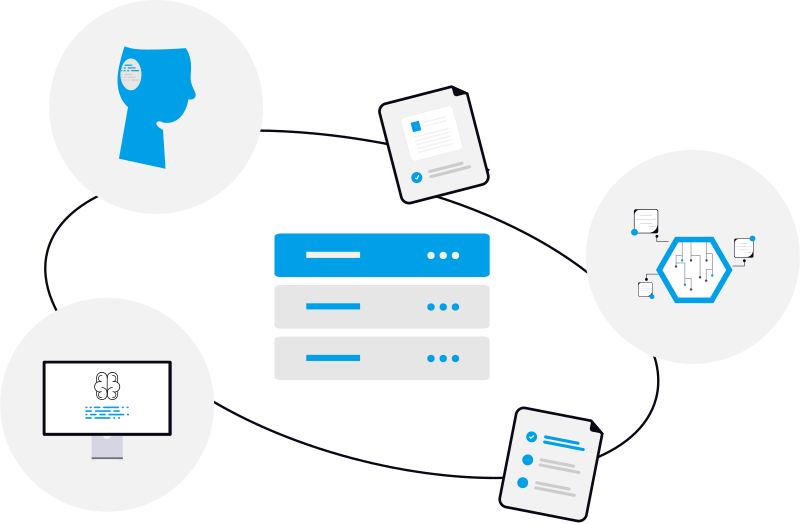
The future belongs to people who understand technology.
AI is reshaping how the world works. That does not make technology knowledge less important — it makes it more essential than ever. SOLVE WITH COMPUTING helps you develop the understanding to work with technology confidently, not just consume what it produces.

If AI can write code, build websites, and analyse data — why should I learn technology?
It is a fair question. And it deserves an honest answer.
AI is genuinely powerful. It can generate code, draft content, analyse data, and automate tasks that once required significant human effort. That is real, and it is worth acknowledging.
But here is what AI does not do well on its own: it does not understand your problem. It does not know your context. It cannot tell you whether its own output is correct. And it certainly cannot take responsibility for the result.
The question is not whether AI is powerful. It is whether you can use it intelligently.
Someone who blindly asks AI for answers is fundamentally different from someone who understands the problem, evaluates the generated solution, identifies mistakes, makes architectural decisions, and knows when the AI is wrong.
That difference — between using AI and understanding technology well enough to use AI effectively — is exactly what matters now.

Using AI is not the same as understanding technology
AI can produce code, but it cannot tell you whether the code solves the right problem, handles edge cases, respects security, or scales under load. That requires human understanding.
Without Understanding
Using AI alone
- Asks AI for answers without understanding the problem
- Cannot tell if the output is correct or broken
- Stuck when the AI gives a wrong or partial solution
- Dependent on tools that change without notice
With Understanding
Technology as leverage
- Understands the problem before reaching for a tool
- Evaluates AI output against known principles
- Identifies errors, edge cases, and architectural issues
- Uses AI to accelerate work they already understand
You do not need to compete with AI.
You need to become someone who can work with it — directing it, evaluating it, and building with it instead of being replaced by it.
A degree can open the door. Practical skills help you walk through it.

Knowledge
Concepts, theory, academic foundations
Application
Building, debugging, shipping, problem-solving
Formal education matters
A degree provides valuable foundations: theoretical knowledge, academic discipline, analytical thinking, and conceptual understanding. These are real advantages that should not be dismissed.
But knowing a concept and being able to apply it to a real technological problem are not the same thing.
Practical exposure builds capability
Building systems teaches lessons that reading alone cannot. Projects expose you to ambiguity, trade-offs, debugging, version control, deployment, and the messy reality of real software.
Practical skills bridge the gap between knowing about technology and being able to use it to solve real problems.
SOLVE WITH COMPUTING is complementary to formal education — not a replacement for it. We help you develop the practical capability that turns knowledge into real skill.
The internet has never had more free knowledge. So why do people still struggle to learn technology?
Free tutorials and online resources can be excellent. The challenge is turning thousands of disconnected resources into a coherent education. Information availability does not automatically produce structured learning.

Random Tutorials
Learning without a system
- Learn whatever appears next
- Different teaching styles and versions
- Little clear progression between topics
- No consistent feedback or correction
- Easy to get stuck without knowing why
Structured Learning
A deliberate path through technology
- Deliberate progression through a curriculum
- Current, maintained learning material
- Connected concepts that build on each other
- Mentorship, feedback, and guidance
- Accountability and community
Free resources can be valuable. Many skilled developers have built careers using a combination of self-study and practice. The question is not whether free content has value — it clearly does. The question is whether random consumption of tutorials is the most efficient path to genuine capability.
Africa does not only need people who use technology. It needs people who understand it.
Africa is participating in a rapidly changing technological world. Digital transformation creates both opportunities and challenges. Businesses, institutions, governments, startups, and communities across the continent need people who can understand, build, improve, and apply technology — not just consume it.
Technology education is not just about individual employability. It contributes to economic growth, innovation, and the ability to solve problems that matter locally.

Software & Digital Services
Building the applications, platforms, and systems that serve communities and businesses.
Data & Decision-Making
Using data to inform policy, business strategy, healthcare, agriculture, and education.
Cybersecurity & Infrastructure
Protecting the digital systems that an increasingly connected continent depends on.
Innovation & Entrepreneurship
Solving local problems with technology — from fintech to healthtech to edtech.

Technology is transforming the world. AI is accelerating that transformation. Fear should not lead to technological ignorance.
The world is changing
AI, automation, and digital systems are reshaping how the world works. This is not something to fear — it is something to understand.
Understanding matters more
People who understand technology can evaluate AI output, make architectural decisions, solve problems, and build things rather than merely consume.
Practical exposure is essential
Formal education provides foundations. But the gap between knowing a concept and applying it requires practice, projects, and guided experience.
Structured learning accelerates progress
Free information is everywhere. A coherent curriculum with mentorship, feedback, and progression turns information into genuine capability.
Africa needs technology professionals
Digital transformation across the continent creates demand for people who can understand, build, and improve technology — not just use it.
Therefore, SOLVE WITH COMPUTING
We exist to help people develop the practical, current, structured technological skills that make them valuable in an AI-driven world.
SOLVE WITH COMPUTING exists to help people move from knowing about technology to understanding it deeply enough to build with it.
We combine structured curriculum, practical projects, current technologies, and personal mentorship to develop genuine technological capability — not just surface familiarity.
Understand First. Build Next.
This is not a slogan. It is how every SOLVE WITH COMPUTING learning experience is designed. We believe that genuine understanding produces better builders than memorisation ever could.

Understand the concept
Before writing any code, you learn what the technology does, why it exists, and how it fits into the bigger picture.
Understand why it matters
Every concept is connected to a real problem. You learn not just what something is, but when and why you would use it.
Apply it through practice
You practise each concept deliberately, building the muscle memory and reasoning skills that tutorials alone cannot develop.
Build real projects
You use what you have learned to build actual software — projects that expose you to real complexity, trade-offs, and decisions.
Debug and reason through problems
When things break, you learn to diagnose, reason, and fix. This is where true understanding develops.
Develop independence
The goal is not to finish a programme. It is to become someone who can learn, solve, and build independently — with mentorship when needed.
Because the goal is not simply to finish a programme. It is to become someone who understands what they are building — and can build it with confidence, independence, and the judgment that AI alone cannot provide.
One platform. Every path into technology.
SOLVE WITH COMPUTING is expanding from our flagship software engineering program into a comprehensive technology academy. Explore live courses and our upcoming disciplines.
Software Engineering
Our flagship program. Build a strong foundation across Git and GitHub, HTML, CSS, JavaScript, React, Node.js and databases through 24 weeks of structured lessons, hands-on projects and live mentorship.

Data Analysis
Turn raw data into clear decisions. Learn to collect, clean, analyse and visualise information that answers real business questions.

Data Science
Go deeper into statistics, modelling and machine learning to build systems that learn from data and predict outcomes.

Mobile App Development
Design and ship mobile applications from idea to production with clean architecture, thoughtful user experience and maintainable code.

Graphics & Web Design
Combine visual design, typography and user experience to craft interfaces that are engaging, accessible and easy to use.

Cybersecurity
Learn to identify vulnerabilities, protect systems and think like an attacker so you can defend digital environments effectively.

Yahya Mohamed Abdulle
Technology Educator • Mentor • Founder of SOLVE WITH COMPUTING
Technology education is personal to me.
I'm Yahya Mohamed Abdulle, a technology educator, mentor, curriculum developer, and the founder of SOLVE WITH COMPUTING.
I started SOLVE WITH COMPUTING because I believe learning technology should be about more than completing tutorials or memorising concepts. Learners need the opportunity to understand how things work, ask better questions, build real solutions, and develop the confidence to keep learning as technology changes.
In an era where AI can generate code, analyse information, and perform increasingly complex tasks, the ability to understand technology becomes even more important.
My goal is simple: help learners move from consuming technology to understanding it — and ultimately, building with it.
Still Have Questions?
Practical answers about what it is like to learn with SOLVE WITH COMPUTING — so you can decide with confidence.

Ready to start understanding technology?
You do not need to be ready. You do not need experience. You do not need to know exactly where you are going. You only need to be willing to start.